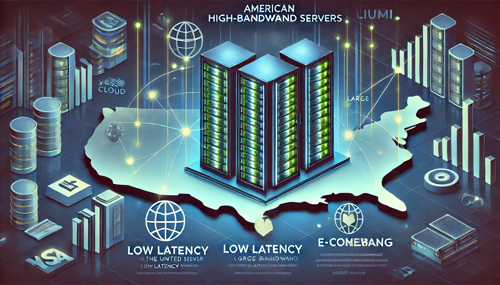
when choosing a server hosting location in the united states, network latency is a key factor affecting user experience and service stability. this article analyzes which cities usually get better network latency from the perspective of network backbone, internet exchange point (ixp), geographical location and business coverage, to help you make more targeted decisions when purchasing server hosting.
northern virginia (ashburn)—the core hub of the east coast
the northern virginia region, especially ashburn, has long been regarded as one of the world's most important data center locations. it is home to a large number of network backbones, cloud service nodes and major internet exchange points, providing low-latency paths for u.s. east coast and transatlantic traffic. if the target users are concentrated in the east united states or transatlantic business, choosing hosting in this region is usually more conducive to reducing round-trip latency and improving redundancy.
new york/new jersey—financial and content distribution hub
there are a large number of internet exchange points and content delivery network (cdn) nodes in new york and new jersey, which are suitable for services that require high-frequency transactions, media distribution, or for large urban agglomerations in the northeast. being close to major ixps and backbone networks reduces the number of transit hops and improves latency performance during peak periods. for applications targeting users in metropolitan areas or in the financial industry, new york/new jersey is a common and effective hosting choice.
chicago—low-latency hub for midwest traffic
chicago is located in the geographical center of the united states, and the network routes connecting the east and west coasts and the midwestern states are relatively direct. for applications that need to cover urban agglomerations in the midwest or schedule traffic between the east and west coasts, chicago can provide a more balanced delay performance and good network redundancy. in addition, multiple large backbone networks converge here, making it an ideal location to reduce cross-regional latency.
los angeles and silicon valley – gateway to the west coast and asia-pacific internet
los angeles and silicon valley are important data centers and network exit points on the west coast. they are close to the landing points of submarine optical cables and have natural advantages in asia and the pacific. if your business needs to take into account delays for users on the west coast of north america and delays in the asia-pacific region, choosing hosting in los angeles or silicon valley can reduce the latency and hop count of transoceanic links, and at the same time benefit from the rich network providers and internet ecosystem.
dallas/fort worth—south central network backbone
dallas and surrounding areas are important network nodes in the south and central areas and are suitable for scenarios that require efficient interconnection between the south and the midwest. there are many backbone optical cables passing through here, connecting the east and west coasts and the direction of mexico, which can provide lower latency and cost-controllable hosting options for southern users. good balance for regional business or inter-state distribution services.
miami – gateway to latin america and the caribbean
miami is the main submarine optical cable landing point and exchange center connecting north america to latin america and the caribbean. if your target users include the latin american market, or require shorter links to the south of the americas, miami can significantly improve network latency and stability to latin american countries. in addition, this area is also suitable for cross-regional disaster recovery and multi-point distribution node layout.
seattle and phoenix—area coverage and disaster recovery options
seattle is close to north american pacific coast users and large cloud service provider nodes, making it suitable for hosting northwest-oriented and cloud-native applications. phoenix's inland location is often used for west coast redundancy and disaster recovery deployments, providing stable access without going through congested coastal links. using these two locations as secondary nodes helps optimize regional latency and improve overall availability.
summary and suggestions
when choosing a u.s. server hosting city, it should be judged based on the geographical distribution of target users, transoceanic export needs, distance from major ixps, and redundant design. common low-latency cities include northern virginia, new york/new jersey, chicago, los angeles, dallas, and miami. it is recommended to do network path testing first (such as routing/latency measurement to the target city), and consider cdn or multi-region deployment to obtain the best experience.

- Latest articles
- Player Guide: Filling In Server Address And Network Optimization Tips For Honor Vietnam Server
- Usage Experience Sharing How Can Cambodia VPS Save Operation And Maintenance Costs In Actual Projects?
- Case Sharing: The Improvement Of Operation And Maintenance Efficiency Brought By Thailand IDC Computer Room Hosting
- Evaluation Report: Is Vultr A Japanese Native IP? Performance Comparison With Other Providers
- How To Judge Whether Thailand Vps Can Meet The Stability Of High Concurrent Access After Purchase
- Industry Standards Interpretation Of Standards And Compliance Requirements Related To Network Cable Routing In German Computer Rooms
- How To Judge Bandwidth Stability And Delay Through Hong Kong Line Equipment Room Prices
- The Transparent Replacement Process And Cost Suggestions Help You Reasonably Estimate How Much It Will Cost To Replace A Server In Thailand.
- Stability Improvement: Hardware And Network Optimization Methods When Taiwan’s Native IP Is Often Disconnected
- How Small And Medium-sized Enterprises Can Use Vietnam Vps Cn2 To Reduce Overseas Operation And Maintenance Costs
- Popular tags
-

Price Transparency Comparison Platform Inventory Helps You Find The Real Prices Of US Class A Servers
Let's review the price transparency comparison platform and teach you how to find the real prices of US Class A servers. Introducing platform features, verification methods, precautions, and operational procedures to help enterprises make rational choices. -
Practical Experience In High-end Data Centers For High-defense Servers In The United States In DDoS Resistance And Bandwidth Redundancy
This article shares practical experience in high-end data centers for high-defense servers in the United States in anti-DDoS and bandwidth redundancy, covering multi-layer protection architectures, link redundancy, traffic cleaning, operations monitoring, and GEO optimization recommendations, making it suitable for enterprises seeking to improve availability and security. -

Corporate Compliance Manual On Internal Control Measures To Prevent Order Brushing On Us Site Group Servers
this article provides an executable compliance framework proposal for the internal control measures in the corporate compliance manual to prevent server fraud, covering risk definitions, organizational responsibilities, technical monitoring, third-party management, approval processes, training and emergency response.